Groundwork: Ease and Freedom to Choose
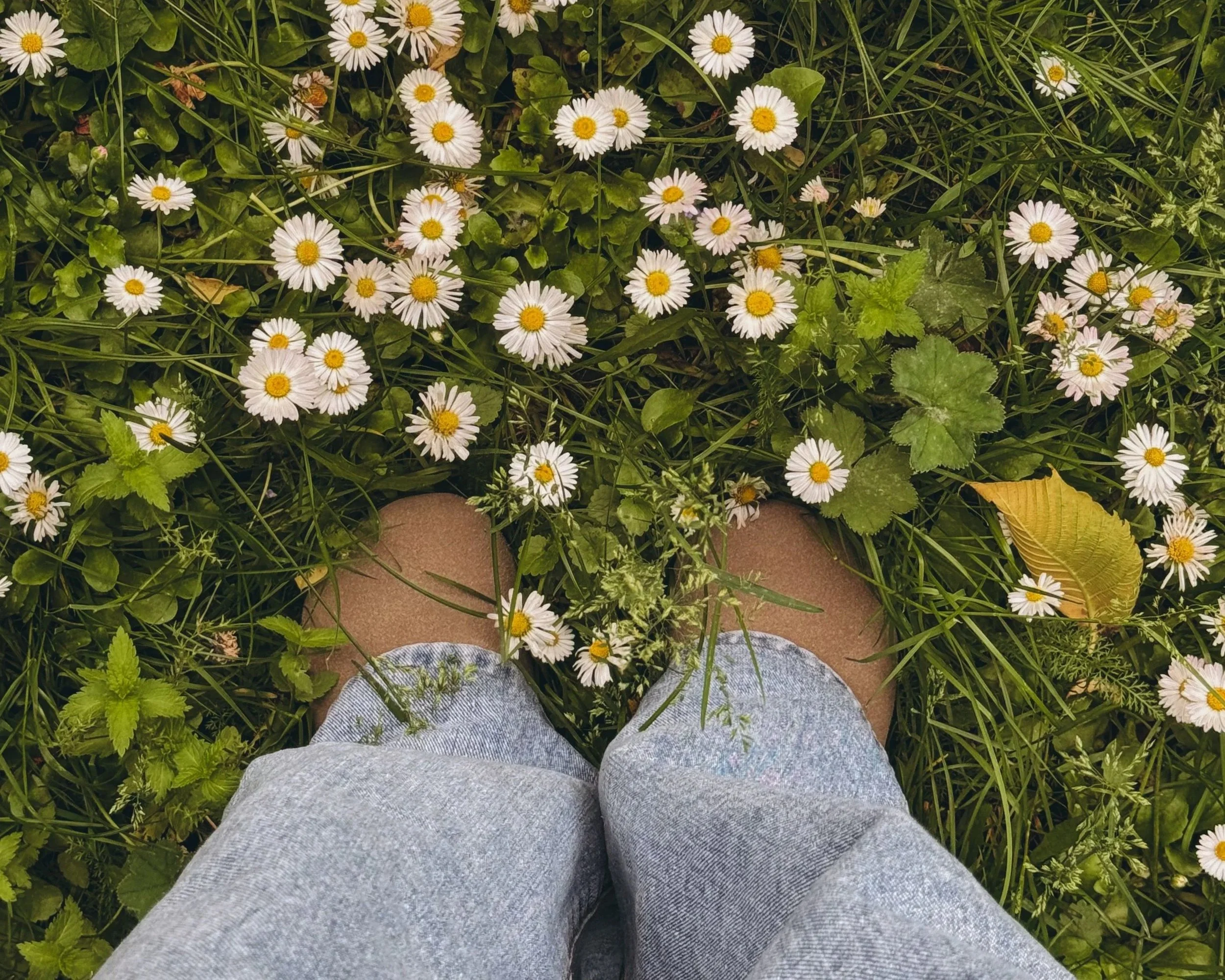
Feet grounded and covered in grass and flowers
Safety First and Choice & A Voice
Safety
When getting started in trauma-informed yoga therapy, I like to emphasize two core tenets right from the get-go: safety first and choice and a voice.
By safety first I don’t mean not wobbling in tree pose, I mean, as much as possible, cultivating a genuine felt sense of ease with me, others (if practicing in a group), the space, and within the practice itself.
I say “cultivating” because I know how hard this can be, especially when you have challenges rooted in traumatic experience or if you wrestle with anxiety.
Together, we work on offering respect and care to any signs of unease that do pop up, while developing the conditions and resources you need to feel more comfortable and capable at your own natural pace.
A felt sense of OK-ness is a focal point when working towards regulating the nervous system, you can read more about why in this post on polyvagal-informed yoga.
Choice and a Voice
One of the primary conditions for feeling more at ease is knowing that you have full agency in every moment and aspect of your practice. This could mean modifying a shape or flow, pausing and rejoining, or stopping altogether.
In fact, at the very heart of yoga practice is growing our capacity for interoception (awareness of internal experience) and discernment (making skilful supportive choices based on what we notice).
I take great joy in collaborating with you to find the practices that click, and in a class context it is a beautiful thing to witness everyone in their own expressions of a shape or flow.
When I started
When I began yoga, I was still struggling with challenges to mainstream practice due to neurodivergence and complex trauma.
- There was the inertia needed to overcome my anxiety or depression and make it to class.
- The need to show up early to ensure I got an isolated spot near a wall.
- The vulnerability of emotions or overwhelm bubbling up in class.
- The comparative rumination cycles and ‘should-ing’ myself seeing everyone else bend and balance like pretzels.
- Repeatedly hearing the teacher direct us to “close our eyes” or “relax” and not being able to, making me feel even more like an outsider.
And I could go on…
Writing this reflection, I am actually sitting here smiling at my long-ago self with a lot of compassion — it is a wonder I stuck with it! And what I would have given for access to a trauma-informed therapeutic space from the start!
Now, as a yoga therapist, I can offer others the resources and skills that help them to grow through their own challenges and create spaces that emphasize permission and freedom to express yourself, receive support, and make personal choices.
Groundwork: anchors for attention and neutral shapes
Before diving into any physical yoga practice, breathwork, or meditation, I encourage exploring what might be a helpful grounding anchor for your attention and a neutral shape for your body.
As with all aspects of practice, the invitation is to be curious and to explore what works for you without any expectations. You conduct informed personal experiments with an open mind as to the results.
In this way, you discover what works best for you personally, and you can slowly build your own tailored skill set with go-to resources for meeting your needs moment by moment.
Engaging in this process builds our Self-trust that we have effective options for meeting physical or mental-emotional challenges.
There are so many options for what might serve as a grounding tool. Here I review a few that many folks find supportive.
The 5 senses
In many cases, focusing our attention on what we notice in the external world can be far more comfortable than turning our attention inward (for example to the breath or the body).
Swipe or use arrows to explore
Sight
- Focus on colours, shapes, textures, patterns
- Intentional focus: out the window, on a picture or quote, on a meaningful object
- Play with softening and broadening the gaze as if taking in the horizon
Sound
- Sounds in the environment: fans, music, traffic, nature sounds
- Intentional sounds: chosen music, chimes, recorded nature sounds, singing bowls
Smell
Taking into account context and sensitivities
- Dried herbs like: lavender, rosemary, mint, rose
- Aromatic tea
- An essential oil roll-on or a couple of drops on a cotton ball
Taste
- Cool water, maybe infused with flavour
- Herbal tea
- A small candy or snack
Touch
- A worry stone or other meaningful small object
- A bead bracelet that can be run through the fingers
- Clothing that feels soothing to the skin
Body based anchors
Concrete body-based anchors (which often combine with sensory perception) can be more nervous system friendly than awareness of feelings, thoughts, or specific breathwork.
Swipe or use arrows to explore
Grounding through the feet
- Wiggle or raise and lower the toes, play with raising and lowering them one by one
- Gently press each foot into the ground, maybe mentally say: “left foot”, “right foot”
- Sway on the soles of the feet side to side and front to back
- Notice the texture of the surface under the feet: rubber mat, wooden floor, carpet, grass
Grounding through the hands and fingers
- Finger tapping: bring the thumb to meet each fingertip in sequence and then the reverse
- Rest the hands where it feels soothing for ex: belly, heart, or both: notice their warmth, gentle weight, and outline
- Rhythmic tapping: using fingertips or cupped hands gently tap areas of the body in a steady rhythm for ex: the chest, upper arms, legs
- Hand mudras: explore traditional shapes made with hands and fingers that feel centring
Grounding through the breath
- Notice your natural inhale and exhale, maybe mentally say “breathing in” and “breathing out”
- Notice where you feel your breath move through your body for ex: chest, abdomen, throat, nose
- Count the natural duration of your breath and see if you can gently invite your exhale to become slightly longer, smoother and softer
Variations
Sometimes a few modifications can make a practice accessible or feel OK to explore including changing your orientation, using props for concrete neutral feedback, or adding movement.
Swipe or use arrows to explore
Orientation
- Standing (with or without support)
- Seated (upright or reclined, with or without support)
- Lying down on the back (extended or knees bent, feet rooted on the ground)
- Lying down on the side or the belly (with or without supportive props)
- Specific shapes like child’s pose or elevating the legs (with support)
Props
- Gentle weight props: light eye pillow, light sandbag, bag of rice, folded towel, hot water bottle, blanket, stuffed animal etc.
- Use gentle weight for soothing: across forehead, tops of feet, lap, shoulders or body
- Use gentle weight for noticing the subtle rise and fall of breath: across lower abdomen or diaphragm
- Tennis ball: roll the soles of the feet over the ball or press and hold in different spots
Movement
- Mindful walking: walk slowly over different surfaces noticing the different textures, feedback and sensation across the soles of the feet
- Movement & breath: simple 2 part movements matched with your inhale and exhale for ex: raising and lowering the arms
- Movement, breath & sound: option to add sound on the exhale like humming or “Voo”
Skilful titration of yoga practice
When we use one of our go-to personal anchors during yoga as a response to rising overwhelm, we are not ‘giving up’ or ‘taking a break’ from the practice, we are embracing its very heart: noticing what is arising or present, checking-in with compassionate curiosity, and making adaptive decisions as to what supports us best in any particular moment.
Especially when practising from a trauma-informed lens, we learn to titrate yoga challenges to avoid emotional overwhelm, dissociation and activating the defensive circuits of our nervous system.
I think of it like slowly making our way into a cool lake: first dipping a toe in to get a sense of the water, then taking it out and noticing how we feel, maybe putting the foot in up to the ankle the next time or, recognizing we need more support before trying to dip the toe in again.
We practice remaining dynamically flexible rather than rigid and forceful. This process of exploring practices on the edge of our comfort zone, pausing to re-set when needed, and then returning to explore the challenge again when ready or with professional support, nurtures our resilience on and off the yoga mat.
Anna is the founder of Take Heart Yoga Therapy, a trauma-informed practice in Toronto. She has been practicing yoga since 2001 and brings both lived experience and professional training to her work with individuals and groups.